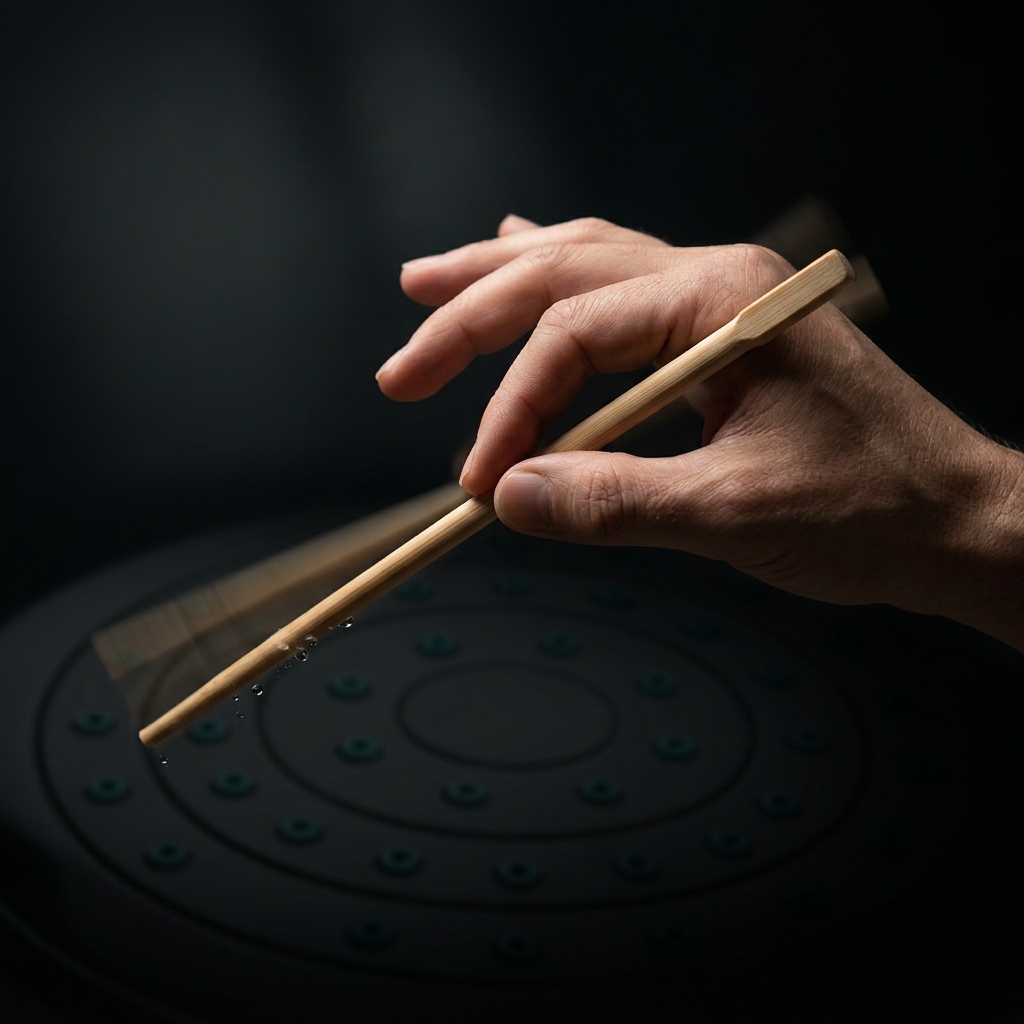
Art & Music
#54 · Conductor's baton
Stand before your imaginary orchestra and command them with sweeping authority. Full commitment is required.
You are not a conductor, and nobody said you had to be. For waving expressively at a recording in the kitchen - or genuinely rehearsing a score before a rehearsal - a chopstick is a perfectly good baton.
How to do it
- Pick a chopstick that feels balanced rather than tip-heavy.
- Hold it near the blunt end between thumb and first two fingers, lightly.
- Beat with the tip, letting the wrist do the work and keeping the arm fairly still.
- Make the downbeat unambiguous. Everything else is negotiable; that isn't.
Why it works
A baton is not for making noise, it is for making a small hand movement visible from thirty metres away. Length amplifies the gesture: a two-centimetre movement at the wrist becomes a much larger sweep at the tip. Real batons are 30 to 60cm and taper for balance, which is close enough to a chopstick for the principle to carry.
Tips & warnings
- Batons are pale so they read against dark clothing. A chopstick painted white genuinely is easier to follow.
- Sand any splinters off first. Enthusiasm plus a rough grip is how you end up with a hand full of bamboo.
- Watch a conductor's left hand sometime - it does something completely different from the right, and that is where the actual expression lives.