Kids & Play
#71 · Counting tool for young children
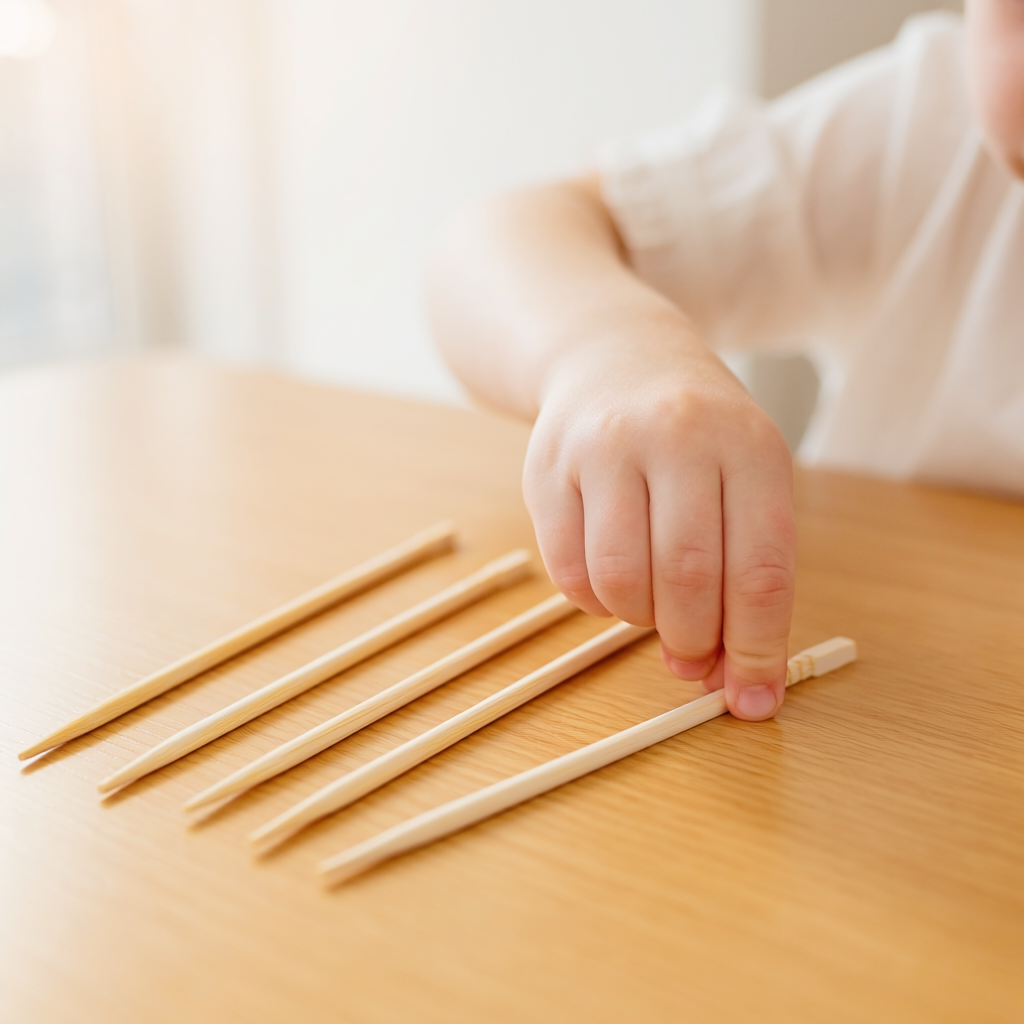
Lay out chopsticks one by one for counting exercises. Physical objects make abstract numbers click in a way screens cannot.
Physical objects beat worksheets when a child is first learning to count. A jar of chopsticks - identical, easy to grip, hard to lose down the back of the sofa - is a genuinely good maths manipulative, and it is the traditional one.
How to do it
- Start with loose counting: give a handful and count them out one by one, touching each as you say the number.
- Move to grouping: count out ten, band them together, and put the bundle aside.
- Build a number from bundles and singles - three bundles and four loose sticks is thirty-four.
- Introduce exchange: ten loose sticks can be banded and become one bundle. Ten ones make one ten.
Why it works
That last step is place value, and it is the concept most children stumble on. A bundle of ten is visibly made of ten ones, so 'the 3 in 34 means thirty' stops being an arbitrary rule and becomes something the child has physically built. Abstract digits cannot do that; bundled sticks can.
Tips & warnings
- Elastic bands rather than string - the bundling and unbundling is the point, so it has to be quick.
- Snap some in half so 'ones' and 'tens' look different at a glance.
- This is the same apparatus as commercial base-ten equipment, at roughly nothing per set.