Gardening
#29 · Dibber for seedlings
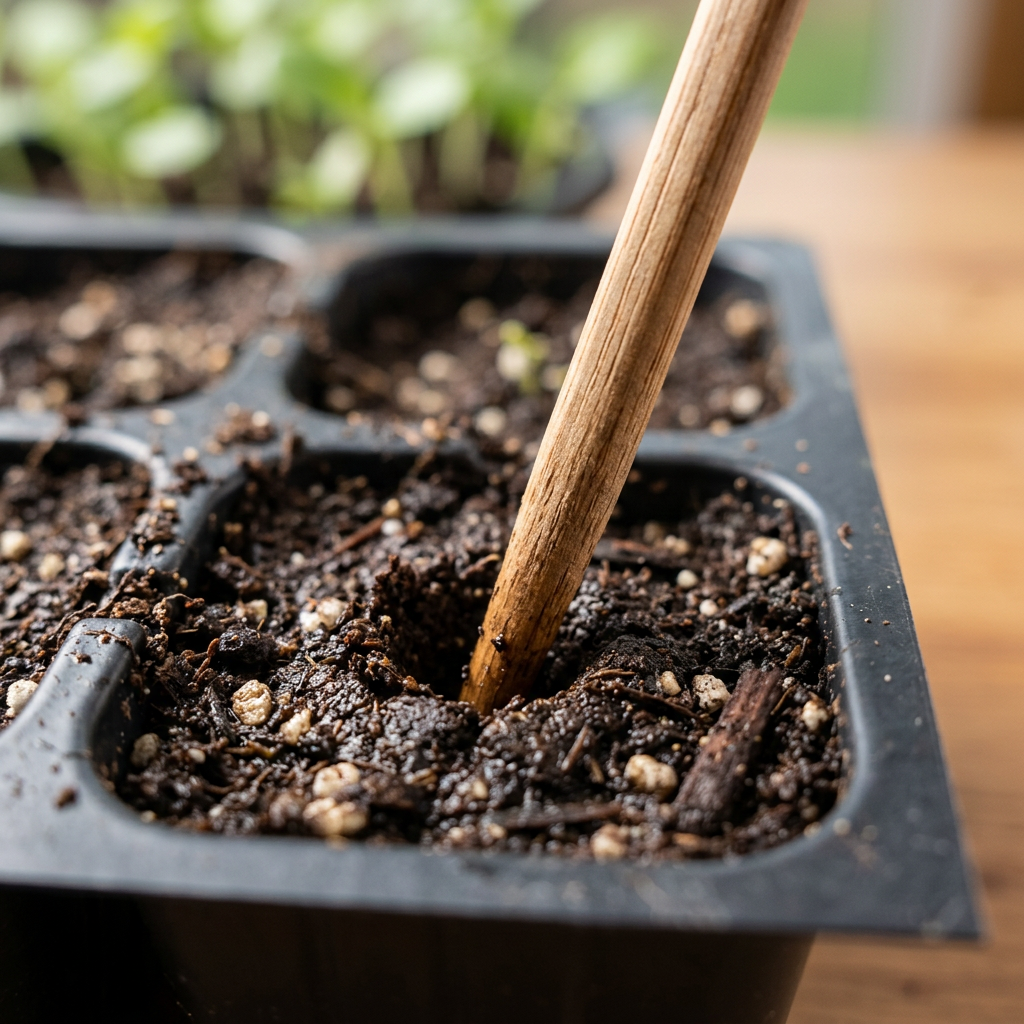
Use the tapered end to create perfectly-sized transplanting holes in a seed tray without disturbing surrounding soil.
A dibber is a stick you poke into soil to make a hole for a seed. That is the entire technology. Garden centres sell handsome wooden ones with brass depth markings for £12, and every gardener who has bought one also owns a chopstick that does the same job in a seed tray more precisely.
How to do it
- Fill your trays or modules with damp compost and firm it gently - not compacted, just settled.
- Check your seed packet for sowing depth. It matters more than almost anything else you do.
- Push the pointed end straight down to that depth. Straight down, not at an angle, so the seed lands at the depth you meant.
- Drop the seed in and cover, pressing lightly so the compost makes contact all round.
- For fine seed like lettuce, use the blunt end to press a shallow depression instead of making a hole.
Why it works
Sowing depth is the main thing that decides whether a seed germinates. Too shallow and it dries out; too deep and it exhausts its stored energy before it reaches light. A chopstick makes a clean-walled hole of consistent depth across a whole tray, which is exactly what a fingertip cannot do.
Tips & warnings
- Mark depth lines at 1cm and 2cm with a permanent marker. This turns a chopstick into a genuinely better dibber than most shop ones.
- A hole made by the pointed end has sloping walls that guide the seed to the bottom - useful for anything small and awkward.
- Wash and dry it between different seed types if you are sowing several in a session.
Common questions
What depth should I use?
The old rule is roughly twice the seed's own diameter, so most small vegetable seeds want about 1cm and beans want 3-5cm. Very fine seed like lettuce and carrot is often barely covered at all. The packet always beats the rule.